
How Thick Should a Dining Table Top Be?
Written by: Kevin
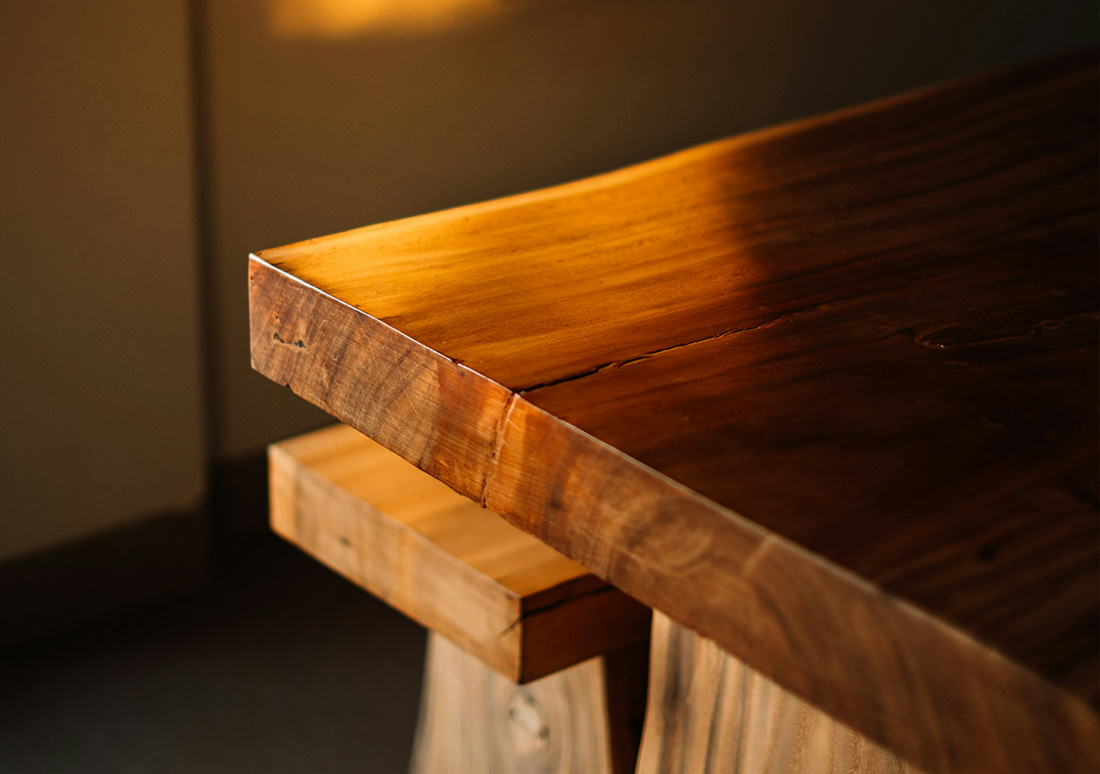
Thickness is the first thing you notice about a table top, and the easiest thing to measure.
Look at any dining table and your eye goes straight to the edge. How deep the wood is. How much it seems to press down on the base beneath it.
You can read it with a glance, or a tape measure, in a way you cannot read joinery or grain. It is also the spec people trust the most and understand the least.
A thicker top is not automatically a better top.
Here is the short version. A solid wood dining table top usually falls between 1 inch and 2 inches thick, and anywhere in that range can be excellent. Thickness does not decide quality or strength. What keeps a long top flat is the structure under it, not the depth of the top itself. The right thickness is the one that looks balanced against the base and the edge, which is a proportion decision, not a number to maximise.
The rest of this is how I think about it, and what the thickness is actually doing.
Does a thicker table top mean better quality?
No. Thickness and quality are not the same thing.
A 2 inch top can be beautifully made or poorly made. A 1 inch top can outlast both.
What tells you about quality is the species, whether the wood is solid rather than veneered, how the top is joined, and how it is held flat. The number at the edge tells you none of that.
Most dining tops land in a fairly narrow band. Common solid wood tops run from about 3/4 inch to a little under 2 inches, and a dining surface usually sits in the lower half of that range.
So the useful range is real, but it is a range. Within it, thicker is a look, not a grade.
What keeps a long table top flat?
This is where the thickness myth does the most damage.
People assume a thick top will not sag and a thin one will. The truth is that a top rests on what is under it, and the support does far more work than the slab on its own.
A rail or apron under the top carries load mostly according to its depth, not its width. Woodworking engineering guidance on table span limits notes that doubling a rail’s height increases its load capacity about fourfold, while doubling its width only doubles it.
Long tables tend to sag before they ever break. They sag when the structure under them is too shallow, not when the top is a quarter inch thinner than the next one.
So a well built 1 inch top on a sound base stays flat. A thick top on a weak base can still dip over a long span.
The depth you cannot see matters more than the depth you can. If you want the fuller picture of how solid wood is held flat and allowed to move, I have written about how solid wood furniture is built to behave.
Thickness is a proportion decision, and the base decides it
Once you accept that thickness is not a quality score, a better question appears. What thickness looks right here?
I think of the top and the base as one decision, not two. A thick top wants a base with enough visual weight to carry it. A thin top wants a base that stays light and lets the surface float.
You can see this in the two directions I build most often. A straight edge top with a slim steel U-base reads clean and architectural, and a thinner top suits it. A thick top wants a bolder pedestal under it, so the mass above has something to sit on.
Each thickness belongs to its base. This is the same logic that governs choosing a base for a heavy slab: the surface and the support are proportioned together, or the piece looks confused.
A heavy top on spindly legs looks nervous. A thin top on a massive base looks like a mistake.
Neither is about quality. Both are about proportion.
How does an edge change how thick a top looks?
Here is the part most people miss. Two tops of the same thickness can look very different, because the edge controls how thick the top reads.
A square edge shows the full depth of the wood. A bevel cut on the underside hides some of it, so the top looks lighter than it measures. Fine Woodworking puts it plainly: steep edges accentuate thickness, while wide, sweeping bevels, especially on the underside, make a top look thinner.
This means thickness is partly a decision you make after the slab is milled. A 1.75 inch top can be made to feel like 1.25 by relieving the underside. The table keeps the mass and strength of the thicker slab, but the eye sees a lighter line.
So when a top looks just right, the edge is often doing quiet work the viewer never notices. It is one of the things worth asking about when you specify a custom top.
What does a solid walnut table top weigh?
Thickness has one consequence that is not about looks at all. Weight.
Solid wood is heavy, and every extra quarter inch adds up fast. Black walnut averages about 38 pounds per cubic foot when dried. From that figure you can estimate a top before the base is even made.
Take a common 84 by 40 inch top. The approximate weights, before any base, look like this:
| Top thickness | Approximate weight (84 by 40 in walnut) |
|---|---|
| 1 inch | about 74 lb |
| 1.5 inches | about 111 lb |
| 2 inches | about 148 lb |
Those are rough figures, and real wood varies. The point is the jump.
Going from 1 inch to 2 inches does not make the table twice as good. It makes it close to twice as heavy, and that weight has to be moved, carried through doorways, and supported by a base for decades.
I build solid walnut and white oak furniture at Redbird, one piece at a time, in Uxbridge, Ontario. When someone asks for the thickest possible top, I usually ask what they are hoping it will do, because the answer is often presence, and presence comes from proportion, not pounds. You can see how that plays out across the walnut dining tables I build on steel bases.
So how thick should your top be?
If I were choosing for a normal dining room, I would start between 1 inch and 1.5 inches for a straight edge table on a steel base, and go thicker only when the base and the room ask for it.
Thicker is not safer. Thicker is not better. Thicker is one choice among several, and it is the one that costs you the most in weight for the least in function.
Choose the thickness that looks settled against the base, suits the edge you want, and leaves you a table you can actually live with. The number at the edge is the last thing that matters, even though it is the first thing you see.
FAQ
Does a thicker dining table top mean better quality?
No. Thickness is a visual and structural choice, not a measure of quality. A well built 1 inch top can outlast a poorly made 2 inch one. Quality comes from solid wood, sound joinery, and a base that holds the top flat.
Is a 1 inch solid wood top too thin for a dining table?
Not at all. Many excellent dining tables have tops around 1 inch, and most antique tops are thinner still. A 1 inch solid top on a well built base stays flat and handles daily use without trouble.
How much does a solid walnut dining table top weigh?
A solid black walnut top around 84 by 40 inches weighs roughly 74 pounds at 1 inch, 111 pounds at 1.5 inches, and 148 pounds at 2 inches, before the base. Walnut averages about 38 pounds per cubic foot, so thickness adds weight quickly.
What makes a thick table top look thinner?
The edge. A bevel cut on the underside hides part of the depth, so the top reads lighter than it measures. A square edge shows the full thickness. The same slab can look heavy or light depending on how its edge is shaped.
Will a long wooden dining table sag over time?
It can, but thickness is rarely the reason. Sag comes from a support structure that is too shallow for the span, not from a top that is slightly thinner. A deep enough apron or stretcher under the top matters far more than the top’s own thickness.
Bring a piece of Redbird Furniture into your home

Kevin
Kevin is the maker behind Redbird Furniture. After years spent building companies, he turned his focus toward working with his hands and creating objects with purpose. He builds furniture with intention, with care for materials, proportion, and longevity. The Redbird Journal documents the space, process, and thinking behind the work.