
Live Edge Dining Tables in Canada: A Buyer's Guide
Written by: Kevin
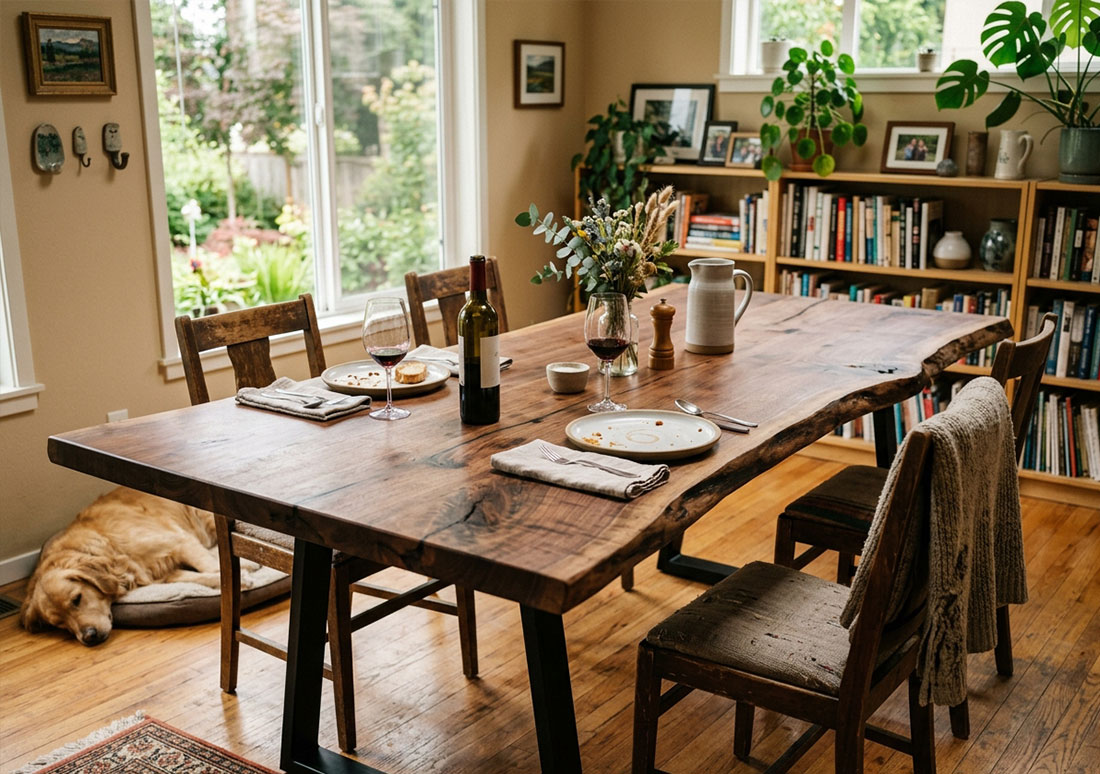
Most of the live edge slabs I turn down look fine in photos. The grain is there, the shape is dramatic, the colour is warm. But when I run my hand across the surface or check the moisture content, the problems show up fast — hidden cracks, unstable drying, sapwood that will not hold finish. That gap between how a slab looks and how it will actually perform is where most live edge dining tables go wrong. It is especially common in the Canadian market, where sourcing varies widely.
If you are reading this, you probably already know what a live edge dining table is. You have seen them online, maybe in person. What you might not know is how much depends on decisions made long before the table reaches your dining room. This guide is about those decisions — the ones that separate a live edge dining room table that holds up from one that does not.
Where the Wood Comes From Matters More Than You Think
I source most of my slabs from sawyers and suppliers in Ontario. That matters for a few reasons. Wood that is harvested and dried locally has already adjusted to the humidity range it will live in. A slab shipped from the southern United States or South America may look striking, but it was dried in a different climate. Once it arrives in a Canadian home with forced-air heating, it can move, crack, or warp. The seller rarely warns you about that.
When someone asks me where the wood comes from, I tell them the truth: I know the people who mill it, I know how it was dried, and I have handled the slab before committing to it. That chain of contact is not something you get from a warehouse or an online marketplace.
The species matters too. Black walnut is the most common choice for live edge dining tables in Canada, and for good reason. It is stable, workable, and carries enough warmth and grain variation to hold visual interest over years of daily use. White oak is another strong option — harder, lighter in tone, with a more linear grain. Both are well suited to Canadian interiors.
How to Evaluate a Slab Before It Becomes a Table
A good slab is not just about the shape of the edge. The things I check first are flatness, moisture content, and structural integrity. A slab that reads above ten percent moisture is not ready to build with. A slab with cracks running into the heartwood may need more stabilisation than the wood can support without looking overworked.
Bark inclusion is another consideration. Some buyers want the bark left on the edge. I understand the appeal, but bark does not bond reliably to the wood beneath it. Over time it loosens, chips, and collects debris. I prefer to remove the bark and clean the edge back to solid wood. The natural contour of the tree is still there — it just will not fall apart in two years.
Drying method also plays a role. Kiln-dried slabs are more dimensionally stable than air-dried ones, but the kiln schedule matters. Rushed drying can leave internal stress in the wood. That stress shows up later as surface checks or warping. I look for slabs dried slowly and evenly, to a moisture content between six and eight percent for Canadian interior use.
The Base Changes Everything
I have seen well-figured slabs ruined by the wrong base. A live edge dining room table needs a base that accounts for wood movement — the seasonal expansion and contraction that every solid wood table goes through. Bases that clamp the slab rigidly across its width will fight the wood. The wood will eventually win, splitting along the grain.
Metal bases handle this well when they are designed properly. A steel base with slotted mounting holes allows the top to move without stress. That is one reason I build most of my walnut dining tables with metal bases — the combination of a warm, expressive top and a clean, structural base gives each piece presence without bulk.
Solid wood bases work too, but they require more careful engineering. Trestle bases and pedestal bases need to be designed so the top can expand and contract freely. If you are commissioning a live edge table, ask your maker how they attach the top to the base. The answer will tell you a lot about how well the table will hold up.
Finish Is Not Decoration — It Is Protection
In a Canadian home, a dining table deals with dry winters, humid summers, spills, heat, and daily wear. The finish has to handle all of that without yellowing, peeling, or feeling plasticky to the touch.
I use a hardwax oil finish on most of my tables. It soaks into the wood rather than sitting on top of it, which means the surface feels like wood, not like a coating. It is repairable — a scratch or a water mark can be sanded out and re-oiled without stripping the whole table. That matters when the piece is meant to last decades, not just survive the first year.
Thick polyurethane or epoxy coatings can protect the surface, but they change the character of the wood. The table looks sealed rather than finished. For a piece where the whole point is the natural edge and the visible grain, I think that trade-off usually is not worth it.
What to Ask a Maker Before You Commission
If you are looking at live edge dining tables in Canada and considering a custom piece, there are a few questions worth asking early in the conversation.
Ask where the slab was sourced and how it was dried. Ask how the maker handles wood movement at the base connection. Ask what finish they use and whether it can be repaired over time. Ask whether the bark will be left on or removed, and why. Ask about lead time — not because shorter is better, but because the answer reveals how the work is paced.
These are not trick questions. A maker who builds live edge tables regularly will have clear, specific answers. Vague responses are a warning sign. If the answers lean on words like “premium” and “artisanal” without saying anything concrete, the work may be outsourced — or the maker has not spent enough time with the material to know its limits.
Sizing a Live Edge Table for a Canadian Dining Room
Live edge slabs are rarely uniform in width. That asymmetry is part of the appeal, but it also means that sizing requires more thought than a standard rectangular table.
I typically start with the narrowest point of the slab. It needs to provide at least 28 inches of usable depth for a dining surface. Anything less and place settings feel cramped. For length, allow 24 inches per seated person. Leave at least 36 inches of clearance between the table edge and the nearest wall or furniture.
In many Canadian homes, the dining room is not a separate formal space. It is part of an open floor plan, connected to the kitchen and the living area. A live edge table in that context needs to feel grounded without dominating the room. Scale and proportion matter as much as the wood itself.
Lead Times Reflect the Work
A live edge dining table built properly is not a quick project. The slab needs to be selected, evaluated, flattened, and sometimes stabilised before any joinery or finishing begins. For my work, lead times typically run several weeks. The exact timeline depends on the scope of the piece and the time of year.
That lead time is not a limitation. It is what allows me to give each piece the attention it needs. Slab selection, flattening, finishing, cure time — none of it should be rushed. If someone offers you a custom furniture commission with a two-week turnaround on a live edge table, ask what is being skipped.
How to Tell What You Are Actually Getting
Not every table sold as “live edge” in Canada is what it appears to be. Some retailers sell tables with a manufactured wavy edge routed into a straight board. Others use thin live edge veneers glued to an MDF or plywood core. These are not live edge tables. They are tables shaped to look like one.
The simplest way to check is to look at the underside. A genuine slab will show continuous grain from top to bottom and edge to edge. The bark line — or the cleaned natural edge — will follow the actual growth pattern of the tree, not a smooth, repeated curve. If the table has a perfectly uniform thickness with no variation, it is probably not a solid slab.
This is not about snobbery. It is about knowing what you are paying for. A solid live edge slab, properly dried, flattened, and finished, will last for generations. A veneer on engineered wood will not. I wrote more about what to know before buying a live edge table if you want the full picture.
A Piece Worth Getting Right
I build live edge tables from my shop in Uxbridge, Ontario, because the material asks something different of me than a straight-edged design. Each slab has its own logic — its own width, its own movement, its own grain pattern — and the job is to work with that instead of against it. The best live edge dining tables are the ones where the maker respected what the wood was already doing and made decisions that supported it.
If you are looking for a live edge dining table in Canada and want to understand more about how the process works, the live edge wood table guide on my site covers the fundamentals. And if you have a space in mind and want to start a conversation about what might work, I am always happy to talk it through.
Frequently Asked Questions
How do I know if a live edge table is real solid wood?
Check the underside. Genuine live edge slabs show continuous grain from top to bottom with no seams or layers. The natural edge follows the actual growth pattern of the tree — not a smooth, manufactured curve. If the thickness is perfectly uniform with no variation, it is likely veneer on an engineered core.
Are live edge dining tables durable enough for daily use?
They are, provided the slab was properly dried and the finish is suited to the environment. I use a hardwax oil finish that protects the surface while keeping the wood repairable. A live edge table built from a well-dried slab, with a stable base connection, will handle daily meals, work, and family life for decades.
What is the best wood for a live edge dining table in Canada?
Black walnut is the most common and, in my experience, the most reliable choice. It is stable, workable, and carries rich grain variation. White oak is a strong alternative — harder, lighter in tone, and well suited to rooms with a cooler palette. Both species dry well in Canadian conditions and hold up to the humidity swings of our climate.
How long does it take to get a custom live edge table?
Lead times vary depending on the maker and the scope of the piece. For my work, most projects take several weeks from slab selection through final delivery. The time accounts for flattening, stabilisation if needed, joinery, finishing, and proper cure time. A rushed timeline usually means something in the process is being cut short.
Should I leave the bark on a live edge table?
I recommend removing it. Bark does not bond reliably to the wood underneath, and over time it loosens, chips, and collects dust and debris. Removing the bark and cleaning the edge back to solid wood preserves the natural contour of the tree while giving you a surface that holds up to daily life.
Ready to Bring a Redbird Piece Into Your Home?
Kevin
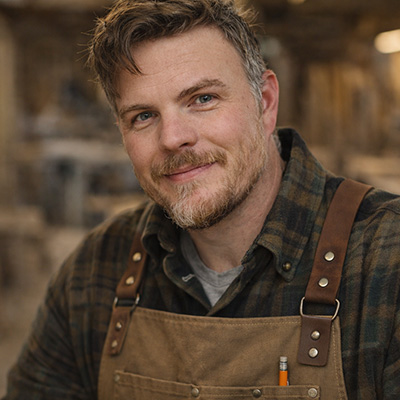
Kevin is the maker behind Redbird Furniture. After years spent building companies, he turned his focus toward working with his hands and creating objects with purpose. He builds furniture with intention, with care for materials, proportion, and longevity. The Redbird Journal documents the space, process, and thinking behind the work.