
What Winter Does to Solid Wood Furniture in Ontario Homes
Written by: Kevin
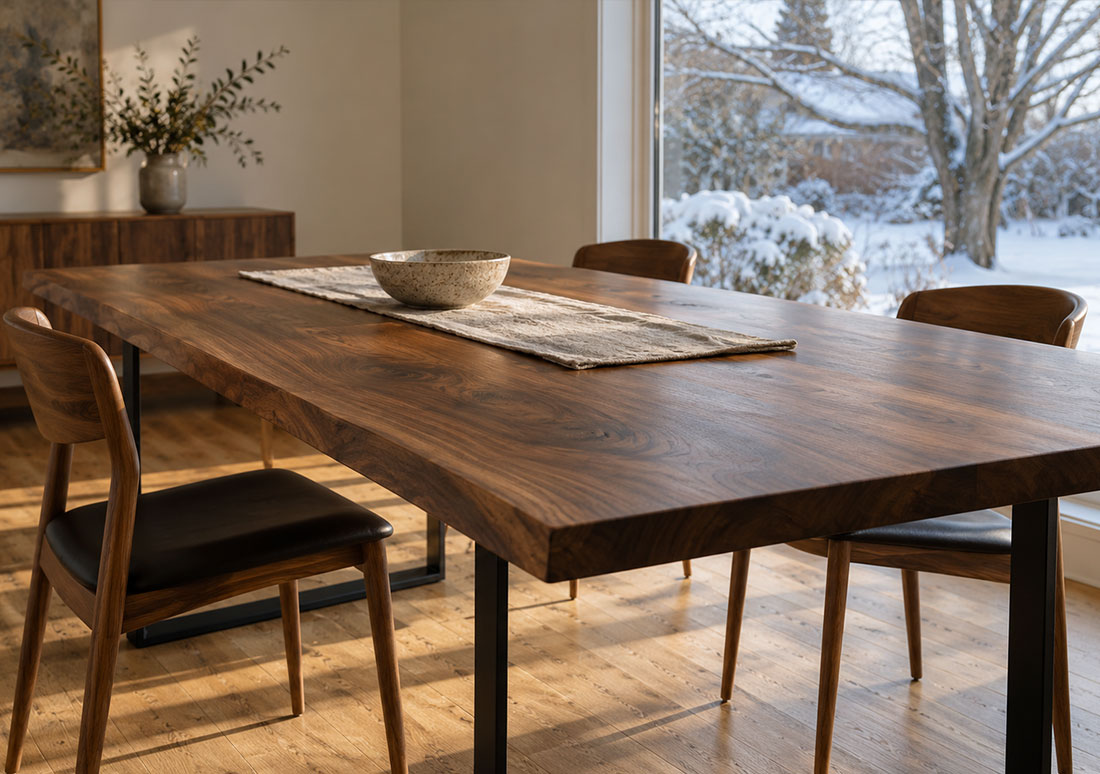
Wood barely moves along its length. Across its width, it moves with every season.
You can check the direction yourself. Look at the end of any board and find the growth rings. The way they run is the way the wood swells in summer and shrinks in winter.
So when someone asks why wood furniture cracks or opens up in winter, the honest answer starts there. Solid wood furniture does not fail in the cold. It shrinks, almost entirely across its width, as dry indoor air pulls moisture out of it.
Here is the short version. In an Ontario winter, the furnace lowers the humidity in your home, and a solid wood table or dresser loses a little moisture and shrinks across its width. A piece built to allow that movement is fine. A faint line, a drawer that runs looser than it did in August, a small gap you notice in January: these are usually the wood behaving exactly as it should. Real cracking happens when the construction fights the movement instead of allowing for it, or when the air changes too fast.
The rest of this explains what is normal, what is not, and the few things worth doing at home.
Why does wood shrink in winter?
Wood is never truly finished taking on and giving up moisture. It moves toward balance with the air around it, all its life.
In summer, Ontario air is humid. Wood takes on moisture and swells. In winter, the furnace comes on, the indoor air dries out, and the wood gives that moisture back and shrinks.
The movement is almost all across the grain. Along the length of a board, wood shrinks only about 0.1 to 0.2 percent, which is why a table never gets shorter in a way you would notice. Across the width, the movement is many times larger.
That is the fact behind most winter furniture worry. A solid wood tabletop does not shrink end to end. It shrinks side to side, and on a wide top that adds up.
How much does a walnut or oak top actually move?
It helps to know the raw numbers first, then scale them down.
The USDA Wood Handbook measures how much a species shrinks from green, freshly cut wood all the way to oven dry. For black walnut, that total is about 5.5 percent radially and 7.8 percent tangentially. For white oak, it is about 5.6 percent radial and 10.5 percent tangential. You can see the full species shrinkage figures in the USDA Wood Handbook.
Those are the full-range totals, not what your finished table does in a season. Furniture wood is already dried and finished, so it only rides the smaller swings between a humid August and a dry January. The seasonal movement is a fraction of the green to dry figure.
Two things follow from the numbers. White oak moves more than walnut across the width, because its tangential figure is higher. And how a board is sawn matters.
A flatsawn board, the common cathedral grain look, moves and cups more than a quartersawn board of the same width. It is one reason quartersawn boards are valued for large tops. They stay flatter through the seasons.
Shape matters too. A round top has no single narrow direction, so it expands and contracts across every diameter at once. If you are drawn to the shape, it is worth reading how a round walnut table handles seasonal movement before you commit to one.
What is normal, and what is not?
Most of what people notice in winter is normal.
A solid wood table that shows a faint line or a slightly open joint in deep winter is usually just narrower than it was in summer. Come spring, it often closes back up. A dresser drawer that glides in July and drags in August, then loosens again in winter, is following the same cycle.
A film finish can move with the wood too. Finishes can crack or loosen slightly as the wood beneath them expands and contracts, so a hairline in the finish is not the table splitting.
What is not normal is a crack that runs and keeps growing, a top that cups badly, or a joint that opens and never recovers. Those point to construction that did not allow for movement, wood that was not properly dried, or air that changed too fast. Wood furniture can split if it is allowed to dry out too far. Good construction plans for the movement so it never gets that far, which is most of what solid wood construction is actually doing under the surface.
Solid wood pieces are not immune to any of this. No solid wood is. The difference is in how the piece is built to move.
Should you set the humidity for your windows or your furniture?
This is where Canadian winters make the advice less tidy than most articles admit.
Your furniture would prefer humidity that does not swing much. Your windows would prefer it low, so they do not sweat and drip in a cold snap.
Those are not the same number. The National Research Council of Canada’s building guidance shows that the colder it gets outside, the lower indoor humidity has to stay to avoid condensation on the glass. In older homes it suggested humidity should probably not exceed 20 percent when the temperature drops below zero. Windows have improved a great deal since then, so treat that guidance on indoor humidity and condensation as the principle rather than a target: cold outside means the safe indoor humidity drops.
So the honest answer is a compromise. You are balancing what the wood likes against what the building can take without condensation.
The good news is that furniture cares less about the exact number than about the speed of change. The Canadian Conservation Institute has moved away from a single fixed humidity target and toward keeping a steady annual average with slow seasonal drift. Gradual is the word that matters. Wood handles a slow seasonal change far better than a sudden one.
What I would do at home
I build solid walnut and white oak furniture at Redbird, in Uxbridge, Ontario, so this is the advice I would give for living with a piece through a Canadian winter.
First, do not chase a magic number. Aim for change that is slow, not a humidity reading that is exact.
If your home gets very dry in winter and you already run a humidifier for comfort, your solid wood furniture benefits from the steadier air too. But watch your windows. If they start to sweat, the air is too damp for the glass, and you back off.
Keep solid wood away from the worst of the dry heat. A table pushed against a hot air register, or a dresser beside a woodstove, sees a harsher swing than the rest of the room.
And give a new piece time. Furniture built in one home needs a few weeks to settle into the humidity of yours. A small amount of early movement as it adjusts is expected, not a fault. This is part of the same seasonal behaviour I describe in my notes on walnut dining tables in Canada.
None of this requires special equipment or fuss. Solid wood has lived in heated houses for a very long time. Built well and treated sensibly, a solid walnut dining table on a steel base handles Ontario winters the way it handles everything else. Quietly, and for decades.
Frequently asked questions
Is it normal for a solid wood table to show small gaps in winter?
Usually, yes. A solid wood tabletop shrinks a little across its width in dry winter air, so a faint line or a slightly open joint is normal and often closes again in spring. A crack that keeps growing is different, and points to construction or drying problems rather than the season.
Should I run a humidifier for my wood furniture?
You can, but it is not required. If your home is very dry and you already run a humidifier for comfort, your solid wood furniture benefits from the steadier air. Watch your windows though: if they start to sweat, the air is too humid for the glass and you should ease off.
Why do drawers stick in summer and loosen in winter?
It is the same seasonal movement, seen from the side. In humid summers a wooden drawer swells and can stick, and in dry winters it shrinks and runs looser. A well fitted drawer is usually built with a little seasonal room so it keeps working through both.
Can dry winter air crack a solid wood table?
It can, but mainly when the wood is allowed to dry out too far or the piece was not built to move. Dry winter air makes solid wood shrink across its width, and construction that fights that shrinkage is where splits start. A table built to allow the movement handles Ontario winters without cracking.
How long does new wood furniture take to adjust to my home?
Give it a few weeks. Furniture built in one environment needs time to settle to the humidity of your home, and a small amount of early movement as it adjusts is expected. After the first season or two you will know its normal range.
Bring a piece of Redbird Furniture into your home

Kevin
Kevin is the maker behind Redbird Furniture. After years spent building companies, he turned his focus toward working with his hands and creating objects with purpose. He builds furniture with intention, with care for materials, proportion, and longevity. The Redbird Journal documents the space, process, and thinking behind the work.