
Walnut vs White Oak Dining Tables: Which Wood to Choose
Written by: Kevin
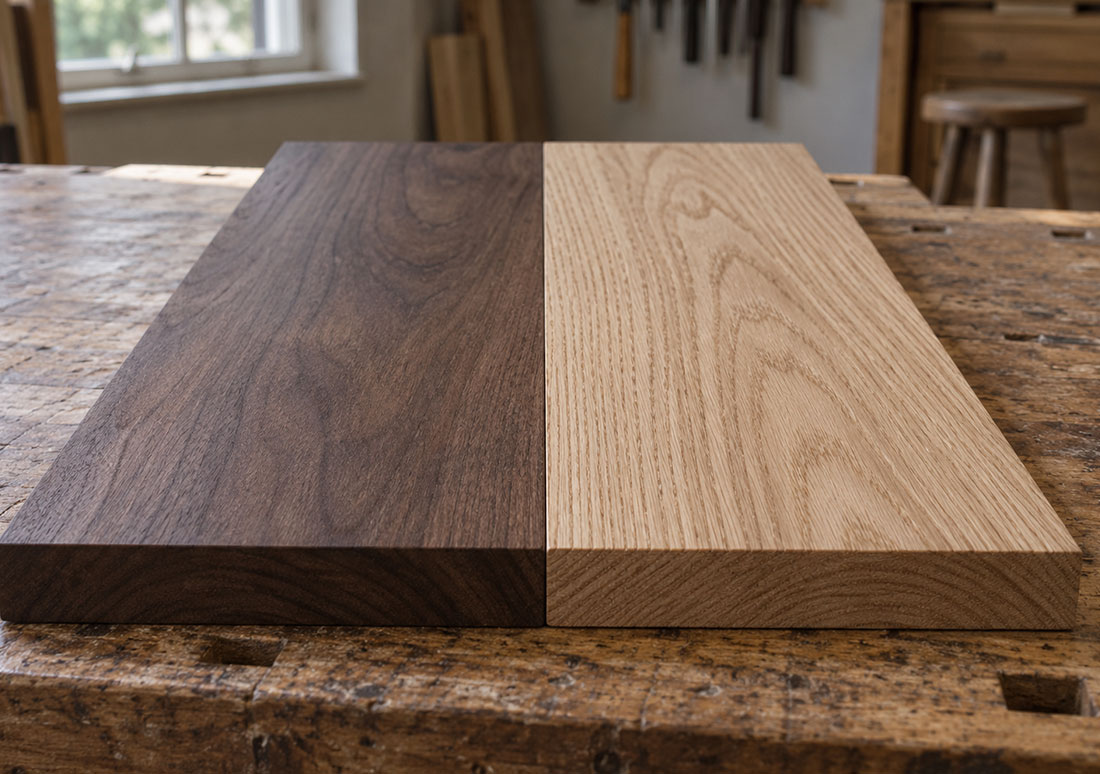
Some mornings I have a walnut board and a white oak board on the bench at the same time.
Same thickness. Same job ahead of them. Cut from trees that grew a few hundred kilometres apart.
Set side by side, they could not look less alike. One is deep and brown and quiet. The other is pale, open-grained, and bright.
People ask me which is better for a dining table. It is the wrong question, but I understand why they ask it.
Here is the short answer. Walnut and white oak both make excellent dining tables, and neither is objectively better. Walnut is darker, softer, and warmer, with a subtle flowing grain that reads calm in a room. White oak is lighter, harder, and more textured, with an open grain and a brighter, more casual feel. Walnut usually costs more. The right choice comes down to the colour you want to live with, how much wear the table will take, and the light in the room it will sit in.
The rest of this is how those differences actually play out.
Colour is the difference you notice first
Walk into a room and the wood tells you its tone before anything else.
Walnut is brown, close to chocolate, with darker streaks running through lighter passages. It reads warm and a little formal. It makes a room feel settled and grounded.
White oak is pale. Somewhere between straw and honey, with a greyish cast in some boards. It reads light and open, closer to a Scandinavian feel than a traditional one.
Both colours shift over time, and they shift toward each other. Walnut lightens and warms as it ages, losing a little of its darkness. White oak deepens and ambers, picking up warmth from light and use.
They never meet in the middle. A walnut table stays a walnut table. But five years in, both look richer than the day they were finished.
White oak is the harder of the two
If you want a number, walnut sits around 1,010 on the Janka hardness scale and white oak around 1,350.
That means white oak resists dents and dings more readily. A dropped serving bowl is less likely to leave a mark.
For a dining table, both are more than hard enough. I have built plenty of walnut tables that have taken years of family meals without complaint. Walnut is not soft. It is just softer than oak.
Where the gap matters is with a very busy table. Young kids, homework, hobbies, daily heavy use. If the table will earn its keep and then some, white oak gives you a little more margin before it starts to show its history.
Though for some people, a table showing its history is the point.
Grain changes how the table feels, not just how it looks
Run your hand across each one and you feel the real difference.
Walnut has a fine, mostly closed grain. The surface finishes nearly smooth, and the figure flows in soft, continuous lines. It is quiet. The wood does not ask for attention.
White oak has open pores and a bolder grain pattern. You can feel the texture under your fingers, and quartersawn oak shows flecks of ray figure that catch the light. It has more visible personality.
Neither is better. But they suit different rooms.
Walnut disappears into a calm, considered space and lets other things speak. White oak brings pattern and life, which is welcome in a plainer room and a lot in a busy one.
Finish behaves differently on each
This is the part most buyers never think about, and it changes the outcome.
Walnut looks its best with a clear, natural finish. The colour is already there in the wood, so there is no reason to stain it. A simple protective finish lets the depth come through.
White oak is more flexible. It takes stain and treatment well, from pale and natural to fumed and dark. Its open pores also mean finish settles into the grain, which deepens the texture rather than hiding it.
So walnut gives you one honest look, done well. White oak gives you range. If you want to steer the final colour, oak is the wood that lets you.
I finish both with low-sheen, durable coatings that protect the surface and can be renewed. On solid wood, a worn finish is something you fix, not something you replace. I go into the wider material picture in my guide to types of wood for furniture.
Cost, plainly
Walnut usually costs more than white oak.
It is a slower-growing, less abundant domestic hardwood, and good wide walnut boards command a premium. White oak is more available at the widths a dining table needs, which tends to keep it a little more affordable.
The difference is real but rarely dramatic on a single table. For most rooms, the choice should come down to look and use, not a modest gap in material cost. Choose the wood you want to eat at for the next twenty years.
How I would decide
Start with the room and the light.
If the space is calm and you want warmth and depth, walnut. If the space is bright, or you want it to feel lighter and more open, white oak.
Then weigh the wear. A hard-working family table leans white oak. A table that will be treated more gently can go either way.
Finally, the finish question. If you want the colour handed to you by the wood, walnut. If you want a say in the final tone, white oak.
I build in both, one piece at a time in Uxbridge, Ontario. Most of my walnut dining tables with steel bases are solid black walnut, but the same designs work in white oak, and a good part of my job is helping people land on the right one. If you are still weighing it, a short conversation through the custom commission process usually settles it faster than more browsing will.
There is no wrong answer here. There is only the one that fits your room, and the one that does not.
Frequently asked questions
Is walnut or white oak better for a dining table?
Neither is better overall, and both make excellent dining tables. Walnut is darker, softer, and warmer with a subtle grain, while white oak is lighter, harder, and more textured. The right choice depends on the colour you want, how much wear the table will take, and the light in your room.
Is white oak more durable than walnut?
White oak is harder, at roughly 1,350 on the Janka scale versus about 1,010 for black walnut, so it resists dents a little more readily. For a dining table, both are plenty durable and last for decades when solidly built. The hardness gap only really matters for a very heavily used table.
Does walnut or white oak cost more?
Walnut usually costs more. It is less abundant and good wide boards command a premium, while white oak is more available at dining-table widths. The difference on a single table is real but rarely large, so look and use should guide the choice more than cost.
Will a walnut or white oak table change colour over time?
Yes, both do, and in opposite directions. Walnut lightens and warms slightly as it ages, while white oak deepens and ambers with light and use. Neither changes drastically, and a good finish that you can renew keeps either one looking its best.
Thinking about a piece of your own?

Kevin
Kevin is the maker behind Redbird Furniture. After years spent building companies, he turned his focus toward working with his hands and creating objects with purpose. He builds furniture with intention, with care for materials, proportion, and longevity. The Redbird Journal documents the space, process, and thinking behind the work.