
Rift Sawn vs Quartersawn White Oak: How the Cut Changes the Furniture
Written by: Kevin
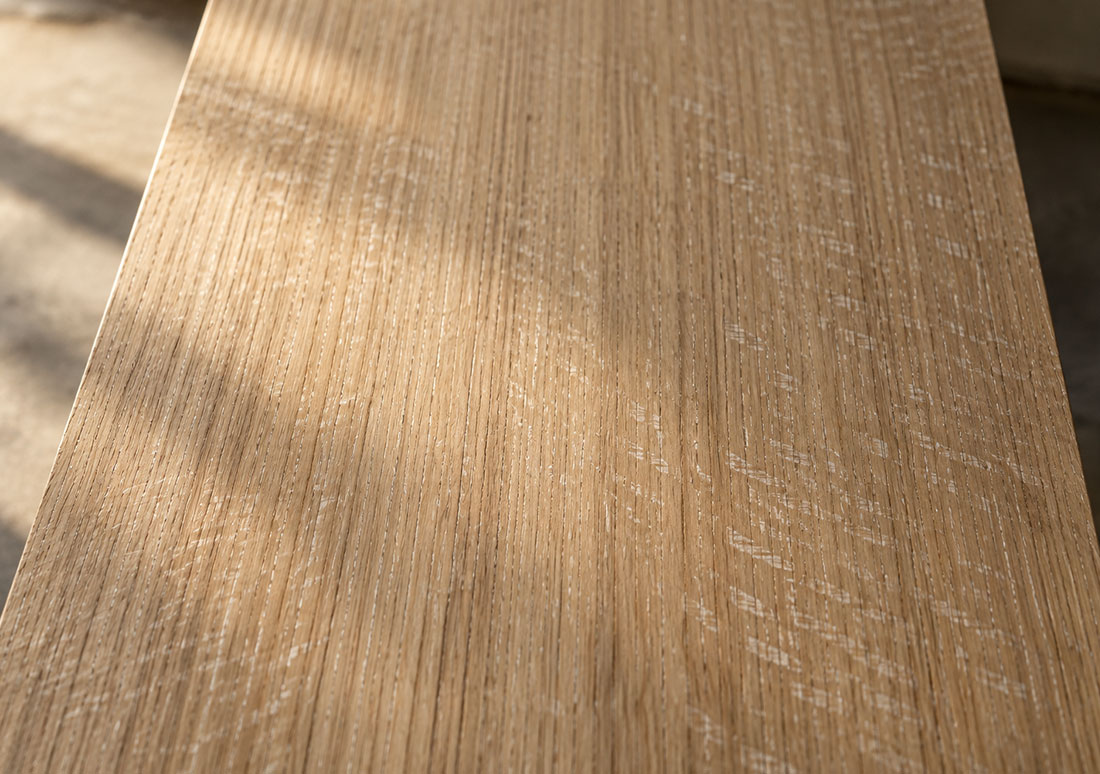
Look at the end of a white oak board. The growth rings tell you how it was cut.
Rings running straight up through the end, close to square with the face, mean the board is quartersawn or rift. Rings curving across in long arcs mean it is flatsawn. Same tree, same species, three different boards.
That is the whole idea behind rift sawn versus quartersawn white oak. You choose the species, but the cut decides how the board looks and how it moves. Quartersawn shows a tight, striped grain with silvery flecks. Rift shows clean, straight grain with no flecks. Flatsawn shows the wide cathedral arches most people picture when they think of oak.
None of them is the best cut. They are different tools for different jobs, and knowing which is which lets you ask for the right one.
Three ways to cut one log
A log is round and boards are flat. How you cut one into the other is the whole question.
Flatsawn, also called plain sawn, is the common way. The log is cut in parallel slices straight through, so the growth rings meet the face at a low angle and give those looping cathedral patterns. It is the most efficient, least expensive cut, which is why most oak furniture is made from it.
Quartersawn means the log is first cut into quarters, then each quarter is sliced so the rings meet the face close to perpendicular. On a true quartersawn board the rings run almost straight up and down across the end grain.
Rift sits between the two. There is no single agreed angle for it. The Architectural Woodwork Institute puts rift at 30 to 60 degrees to the face, while the wood scientist R. Bruce Hoadley uses 45 to 90 degrees, a disagreement Wikipedia lays out plainly. The practical result is the same: a board with very straight, even grain and almost none of the fleck quartersawing produces.
Why does quartersawn white oak have those flecks?
The flecks are the signature of the cut, and they come from inside the tree.
Oak has medullary rays: ribbons of cells that run from the centre of the trunk outward, like spokes on a wheel. In most cuts you never see them. When a board is quartersawn, the saw passes nearly along those rays and exposes them on the face. That shows up as ray fleck, the shimmering, almost metallic patches that catch the light.
The fleck has been prized for a long time. In the early 1900s, Gustav Stickley built his Mission furniture from quartersawn white oak for it, while cheaper imitations used ash stained to look like oak, which gave the colour but never the fleck. It was the tell then, and it still is.
Why does the cut change how a board moves?
Wood moves with the seasons. It takes on moisture in humid months and gives it up in dry ones, changing size as it does. The part that matters here: it does not move evenly in every direction.
White oak shrinks about 10.5 percent along the growth rings, called tangential movement, but only about 5.6 percent across them, called radial movement, measured from green to oven dry by the USDA Forest Products Laboratory Wood Handbook. Those are full green-to-dry totals, not seasonal figures, but the ratio is the point. White oak moves close to twice as much in one direction as the other.
On a flatsawn board, that larger movement runs across the width, so flatsawn oak expands, contracts, and cups the most. On a quartersawn or rift board, the rings stand up through the thickness, so most of the movement goes there, where it barely shows. The board stays flatter across its width.
That is the quiet reason the quieter cuts exist. A quartersawn or rift panel holds its shape through an Ontario winter better than a flatsawn one. For the fuller picture of how solid wood is built to expand and contract without failing, I have written about how solid wood furniture is made to behave.
Where each cut tends to be used
Because the cuts behave differently, they tend to land in different parts of a piece. This is general practice, not a rule.
Rift is the usual choice for legs and other square parts. Its grain runs dead straight, so a rift leg shows the same clean lines on all four faces, with no cathedral arch wandering around a corner. Furniture makers favour it for exactly that reason.
Quartersawn shows up where stability and fleck both earn their place: door panels, cabinet sides, and tops that want the striped grain and the extra flatness. Flatsawn is used where the wide, open grain is the point, or where cost and yield matter most.
A single piece often mixes all three, the cut chosen part by part for how that part needs to look and behave.
Is white oak better than red oak for furniture?
This is the other question that comes up, and the honest answer is that it depends.
White oak and red oak are different woods, not grades of the same one. The clearest difference is hidden inside the wood. In white oak, the tiny vessels that carry water are mostly plugged with structures called tyloses. A 2024 study found about 14 percent of white oak vessels were filled with tyloses, against about 1.7 percent in red oak, reported in Scientific Reports. That is why white oak can hold liquid, which is why barrels are made from it, and red oak cannot.
For furniture, white oak is generally preferred for its tighter grain, warmer tone, and that closed structure, which also helps it resist moisture. Red oak is more open and more pink. Neither is wrong. But when people picture the calm, pale, modern oak look, they are usually picturing white oak. For a closer look at matching a species to a room, I have compared how walnut and white oak behave in a dining table, and written more broadly about choosing a wood species for furniture.
Why do the quieter cuts cost more?
Quartersawn and rift oak almost always cost more than flatsawn, and the reason is simple geometry.
To get the rings square to the face, you cannot run a log through in parallel slices. You quarter it first, then cut each quarter at an angle, giving up more of the log as you go. The boards come out narrower and the yield per log drops. More waste and more handling mean a higher price.
So on a quote, rift or quartersawn is not a marketing word. You are paying for a more stable board that the log gave up more of itself to produce.
I build solid walnut and white oak furniture at Redbird, one piece at a time, in Uxbridge, Ontario. When someone asks for white oak, the cut is part of the conversation, because it decides both the look and how the piece behaves. A straight rift leg, a quartersawn panel, a flatsawn top: each is a decision, not a default. Settling that well is part of what a custom furniture commission is for.
FAQ
What is the difference between rift sawn and quartersawn oak?
On a quartersawn board, the growth rings meet the face close to perpendicular, which gives a tight striped grain and the silvery ray fleck. On a rift board, the rings sit at a shallower angle than quartersawn, often cited as 30 to 60 degrees to the face, giving very straight grain and almost no fleck. Both come from cutting across the rings rather than parallel to them, which is why both are more stable than flatsawn oak.
Why is quartersawn white oak more expensive?
Quartersawn oak costs more because of how little of the log becomes usable board. The log has to be quartered and cut at an angle, which produces narrower boards and more waste per log. You are paying for lower yield and more handling, not a premium label.
What are the flecks in white oak?
They are called ray fleck. Oak has medullary rays that run outward from the centre of the trunk, and quartersawing slices nearly along their length, exposing them on the face. They look like shimmering, almost metallic patches, and they are the clearest sign a board was quartersawn.
Does quartersawn wood move less than flat sawn?
Across its width, yes. White oak moves close to twice as much tangentially as radially, so a quartersawn or rift board, with its rings standing up through the thickness, sends most of that movement into the thickness where it barely shows. The board stays flatter and cups less than a flatsawn one, though no solid wood is ever completely still.
Is white oak better than red oak for furniture?
For most furniture, white oak is the usual choice. Its vessels are mostly plugged with tyloses, which closes the grain, helps it resist moisture, and is why it is used for barrels, while red oak is more open and more pink in tone. Red oak is not a lesser wood, but the calm, pale, modern oak look most people want is white oak.
While you're here, why not check out our custom and signature pieces?

Kevin
Kevin is the maker behind Redbird Furniture. After years spent building companies, he turned his focus toward working with his hands and creating objects with purpose. He builds furniture with intention, with care for materials, proportion, and longevity. The Redbird Journal documents the space, process, and thinking behind the work.